Manufacturing companies in the field of discrete, customer-specific production (“make-to-order”) generally operate in market niches in Austria. They are characterized by a high degree of specialization (high competence in individual process steps and associated manufacturing technologies in the value chain) and flexibility (high willingness and ability to fulfill individual customer requirements) as a competitive advantage. Production is therefore usually characterized either as small-batch or individual production and organized either as island or workshop production. The high variability of customer requirements as a result of increasing customization leads to a high degree of complexity in order structures (variable, sometimes volatile, work content combined with variable, sometimes volatile, order quantities). This complexity poses particular challenges for the management of production systems with regard to the optimization of the logistical target variables of capacity utilization, inventory, delivery reliability, and delivery time. This is particularly true because increasing cost pressure and the lack of availability of skilled workers are pushing many manufacturing companies towards further automation. This applies particularly, but not exclusively, to small and medium-sized manufacturing companies.

Dieses Projekt wird aus Mitteln der FFG gefördert (www.ffg.at).
Major goals of this project are:
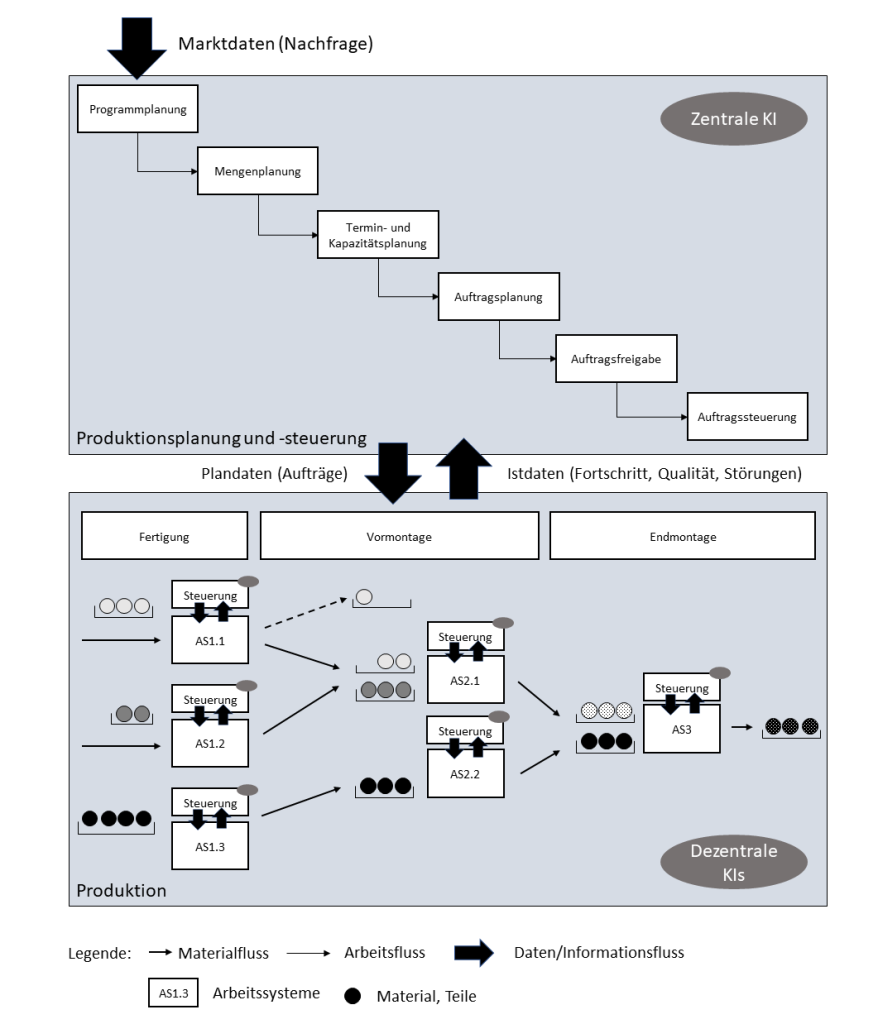
(1) the research and development of novel planning and control concepts based on the combination of classical planning and control methods with artificial intelligence methods (especially machine learning) for production scenarios with very high volatility and variability in terms of product variants, order quantities, raw material/part quality, with a simultaneous high degree of automation and a high degree of human-machine collaboration,
(2) the development of a configurable simulator and demonstrator that allows manufacturing companies to test, evaluate, and further develop various AI-enriched decentralized planning and control concepts for production scenarios with high variability and volatility regarding product variants, order quantities, and raw material/part quality (development and test bench for AI-enriched production planning and control concepts).
To date, there is no competence center for the systematic research, development, evaluation, and testing of AI methods, especially machine learning methods, for production planning and control in the context of custom and small-batch production. Research has so far focused primarily on static planning and optimization methods. Production systems as dynamic systems that learn during operation in the context of typical production scenarios of custom and small-batch production and their boundary conditions have received little research.