
WP2: Use cases for the application of AI in production planning and control
In this work package, we investigated potential use cases in single-item and multi-variant series production. We conducted 12 interviews with companies in the field of highly specialized make-to-order manufacturing. The companies were selected based on their potential to contribute to identifying use-cases and an in-depth understanding of perceived challenges. Of the 12 participating companies, 10 are classified as SMEs, 2 are defined as large companies. Five of the companies are assigned to custom manufacturing and 7 to small batch production. Sectors companies work in range from custom machine manufacturing to parts and electronics manufacturing. All companies interviewed manufacture from batch size 1 to larger batch sizes. Transcription of interviews was conducted manually and resulted in 222 pages of data. Coding was conducted with software MAXQDA. We identified 5 prevalent use-cases from interview material. These use-cases were perceived critical to the interviewees, identified as hard to manage with traditional methods and therefore having potential for new AI-supported methods. The use-cases were finally related to typical Planning and Control tasks and potential AI approaches (methods). Results are shown in table 1.
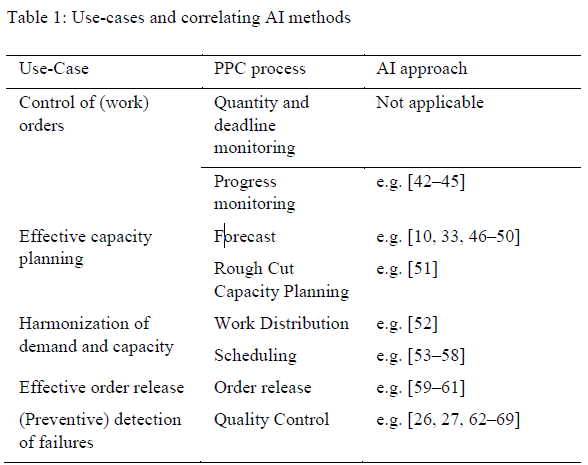
A paper summarizing results has been published on 57th CIRP Conference on Manufacturing Systems 2024 (CMS 2024) and can be retrieved via the publishers website. For more information about results please contact:
Roman Hörbe (roman.hoerbe@fhwn.ac.at)
WP3: Novel concepts of AI-supported production planning and control
For the use-cases identified through interviews and additional use-cases identified through a literature review we developed new process models that integrated a data and AI perspective. For this purpose we first developed a matrix that lists all use-cases related to typical PPS tasks. Then we investigated the suitability, data requirements and potential of various AI-based methods. Given the ever increasing number of AI-based methods we did a systematic literature and technology review to identify potential AI-methods and software frameworks. Use-cases, data requirements, limitations and potential of various AI-methods were made available through a database and user-interface. Manufacturing companies can search for use-cases or PPS tasks and get information regarding potential AI-methods and technologies. In addition a guideline is developed that supports companies in narrowing down the AI-solution space for particular tasks in PPS. An excerpt of the matrix is shown below.
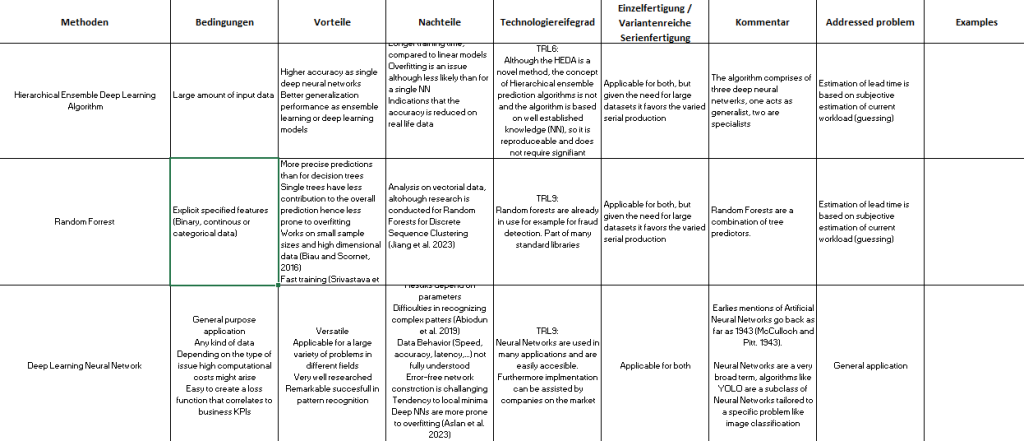
The matrix is accessible here.
This work package is currently in its final stage. For more information about results please contact:
Roman Hörbe (roman.hoerbe@fhwn.ac.at)
WP4: Simulators – AI use in production planning and control
Through simulators for different PPS tasks we show the potential of different AI methods. Simulators have been developed using Anylogic Simulation Software. We used a combination of agent-based modeling and discrete event modeling to create models. We have chosen two example products and production line layouts as a basis for developing the AI simulators. We developed AI-based algorithms for PPS tasks which then were integrated into the simulation models. The simulators allow to compare advantages of AI-based methods against traditional approaches in planning and control.
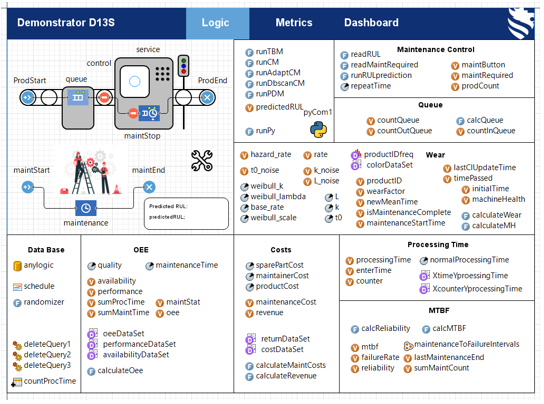
The image shows a simulator (D13S) for simulating anomalies in machine data and failures and their impact on capacity planning, costs and lead times. This work package is currently in its final stage. For more information about results please contact:
Gabor Princz (gabor.princz@fhwn.ac.at)
>> Read more about results here.
WP5: Demonstrators – AI use in production planning and control
To show the feasibility of theoretical models and simulators we developed lab demonstrators. Lab demonstrators consist of two example products and respective production lines. One production line is targeted at multi-variant production of a pneumatic cylinder, the other is targeted at custom production of a robot soft gripper. The demonstrator for multi-variant production of a pneumatic cylinder is based on a FESTO FMS 50 learning factory. The demonstrator for the custom soft gripper is based on a combination of work stations for 3D printing the fingers and mounting plate, and a robot cell for assembly of fingers, plate and pother parts. The production order planning and control is performed through an open source ERP system (Odoo). AI-based solutions have e.g. been developed for demand forecasting and planning, purchase and production order scheduling, capacity planning, image based quality inspection, and machine failure detection.
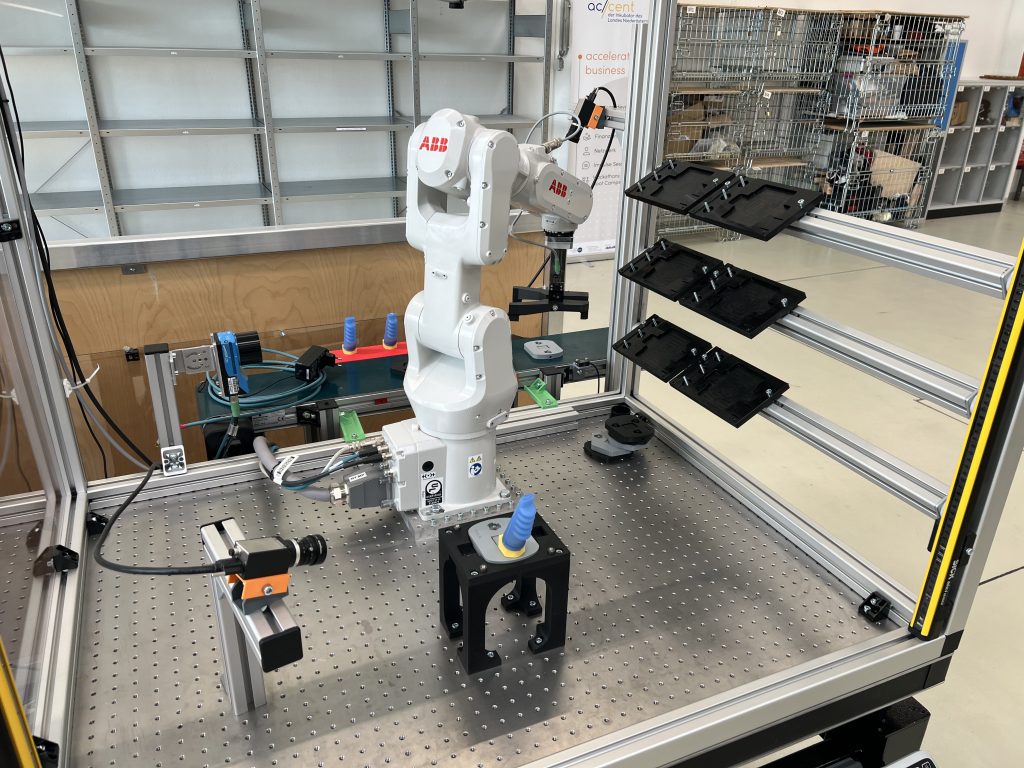
The image below shows our demonstrator for customer specific assembly of a soft gripper. This work package is currently in its final stage. For more information about results please contact:
Roman Hörbe (roman.hoerbe@fhwn.ac.at)