
Introduction
Simulation is a method for model-based representation of real processes, systems, or workflows, which makes it possible to analyze their behavior under different conditions without interfering with actual production. In industrial applications, three main types of simulation are commonly used: discrete-event simulation, which models temporally separated events such as order releases or machine failures; agent-based simulation, which represents decentralized decisions of individual actors such as machines, orders, or employees; and system dynamics, which describes continuous, feedback-driven processes such as material flows or inventory developments.
The use of simulators provides companies with the advantage of better understanding complex interrelationships, evaluating the effects of decisions in advance, identifying bottlenecks, and testing process improvement measures without risk. This enables well-founded decisions to be made for production planning, maintenance, or resource management.
In Work Package 4, different simulators were developed for both variant-rich series production and single-item production, based on the findings of Work Packages 2 and 3. The aim is to compare traditional and novel PPC (Production Planning and Control) concepts in order to evaluate their performance and applicability in various production environments. Instead of defining only one simulator, several tasks within PPC were identified. For each of these tasks, a specific simulator was developed that can be used either for single-item production (EF), for series production (SF), or even for both production types.
The developed simulators serve to visualize the potential of selected application cases in the industrial context. The goal is to demonstrate to companies the possible applications of machine learning methods in production planning and control. Among other things, the simulators support forecasting demand patterns and order release times, load-oriented optimization of job releases, and classification of disturbances and setup operations to enable early derivation of appropriate measures. In addition, they allow for the analysis of key figures such as Overall Equipment Effectiveness (OEE), in order to identify potential for increasing process stability as well as optimizing resource and capacity planning. Maintenance processes are supported, for example, by predicting maintenance intervals and better planning of repair interventions.
The simulators are designed in such a way that they can be adapted to different operational conditions through a wide range of adjustable variables and parameters. They are based on the current state of industrial practice and also integrate at least one innovative concept to demonstrate new approaches in the areas of production control, maintenance, or data-driven decision support.
D1S Simulator – Forecast of demand and production volumes using Artificial Intelligence
The D1S simulator was developed to demonstrate the use of artificial intelligence (AI) methods in production planning. The goal is the data-based forecasting of demand and production volumes in variant-rich series production. The simulation models typical uncertainties in customer demand and demonstrates how AI models can contribute to improving planning accuracy.
Initial Situation
In many industrial applications, only incomplete or inaccurate demand forecasts are available from customers. Fluctuating demand patterns and short-term changes complicate production planning. Classical methods such as moving averages or linear extrapolation reach their limits when dealing with highly variable or non-seasonal demand.
Objective
The simulator shows how historical demand patterns with different fluctuations can be simulated and analyzed based on external influencing factors (e.g., raw material prices). With the help of an integrated AI model (LightGBM), future demand for a defined period is forecast. This makes the potential of data-driven forecasting methods visible.
Technical Implementation
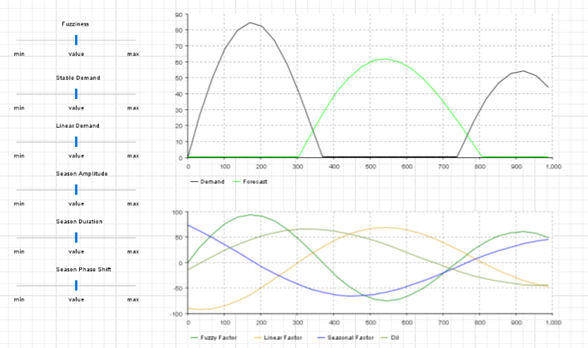
The application was implemented using AnyLogic and extended with several Python scripts. The simulation is carried out in several steps:
- Demand simulation over 800 days based on defined parameters (seasonality, trend, randomness, external influence),
- Transfer of the simulated data to the AI model (LightGBM),
- Forecast of demand for another 200 days (days 801–1000),
- Comparison of the forecast with the actual developments using RMSE (Root Mean Square Error) to evaluate the forecasting quality.
Data is exchanged in CSV format to ensure simple integration and traceability. The influencing factors can be adjusted via a user interface during the simulation.
Results
- A total of 2,592 different demand scenarios were simulated and individual models were trained for each.
- The calculated error metrics (RMSE) show that the AI model achieves higher forecasting accuracy than classical methods, especially for complex developments.
- The simulation can be executed platform-independently and is suitable for use in teaching, workshops, or for internal evaluation of forecasting methods.
D2S Simulator – AI-supported medium-term resource planning
The D2S simulator demonstrates how companies can improve their medium-term resource planning with the help of simulation and artificial intelligence. The aim is to identify capacity requirements under uncertainty at an early stage and support well-founded decisions for resource allocation.
Initial situation
Many industrial companies face high uncertainty regarding future capacity requirements. Reasons include short-term customer orders, fluctuating demand, schedule changes, as well as external influencing factors such as seasonal effects or market changes. Available capacities often do not match actual demand, which can lead to under- or over-utilization.
Objective
The D2S simulator simulates the development of resource requirements over a longer period of time and forecasts the necessary resource usage – for example, machines or personnel. Nonlinear effects such as quality, performance, or downtime losses are also taken into account. The aim is to enable stable planning despite volatile conditions.
Technical implementation
The implementation is carried out in AnyLogic with integrated Python scripts and AI algorithms. The simulation focus is on medium-term capacity development, not on short-term detailed planning (no event simulation). The key features include:
- Inputs: sales forecasts, development of customer demand, resource parameters
- Outputs: temporal development of machine requirements including sudden changes (e.g., due to seasonal effects
• Outputs: Temporal development of machine requirements including sudden changes (e.g., due to seasonal effects)
To see a video of this simulation go to our video page.
The forecast is carried out in regular planning runs (every 90 days) using the following methods:
- LightGBM for forecasting sales over two quarters
- Artificial neural network for deriving the resulting resource requirements
Different model variants were tested. It was found that specialized models for each product variant performed better than generic approaches. In addition, LightGBM outperformed other methods such as LSTM while using minimal features.
Results and Key Figures
The simulator enables the quantitative evaluation of different planning strategies based on key performance indicators:
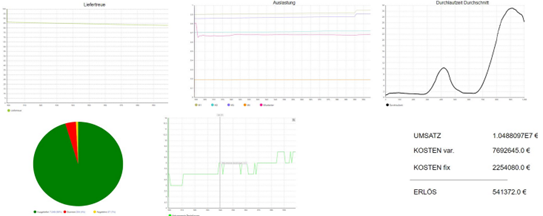
- Delivery reliability
- Resource utilization
- Average lead time
- Ratio of fulfilled, canceled, and rejected orders
- Variable and fixed costs
- Revenue development
A comparison between the classical and the AI-based approach shows that optimized resource utilization can achieve higher profitability. At the same time, it becomes clear that the AI approach reaches its limits in the event of sudden demand peaks, which can lead to a higher cancellation rate. Nevertheless, the advantages outweigh the disadvantages overall, particularly with regard to efficiency and revenue.
D4S Simulator – Forecast of lead times and delivery dates in single-item production
The D4S simulator demonstrates how companies in single-item and small-batch production can improve the predictability of their delivery dates by combining simulation and machine learning (ML). The aim is to provide realistic lead time forecasts and thus create a solid basis for reliable scheduling decisions.
Initial Situation
In single-item production, products are often characterized by high variability, different complexity, and variable manufacturing processes. This makes an exact prediction of lead time (LT) difficult. Fluctuating order volumes, changing processing sequences, and varying resource availability increase uncertainty. Classical scheduling methods such as forward, backward, or midpoint scheduling reach their limits here.
Objective
The simulator models various production scenarios of a workshop-based single production and uses ML models for data-based prediction of lead times. The goal is to increase delivery reliability, avoid delivery delays, and support production planning. In addition, the transition from single-item production to more efficient small-batch production is to be prepared.
Technical Implementation
The model was developed in a simulation environment and combined with ML algorithms such as Linear Regression (LR), Random Forest (RF), and Gradient Boosting Machines (GBM). Methods used include:
- Simulation of varying production processes and scenarios
- Use of product-related features (e.g., complexity, process sequence) as input features
- Training and dynamic adjustment of ML models with simulation data
- Iterative learning to improve model accuracy as data collection progresses
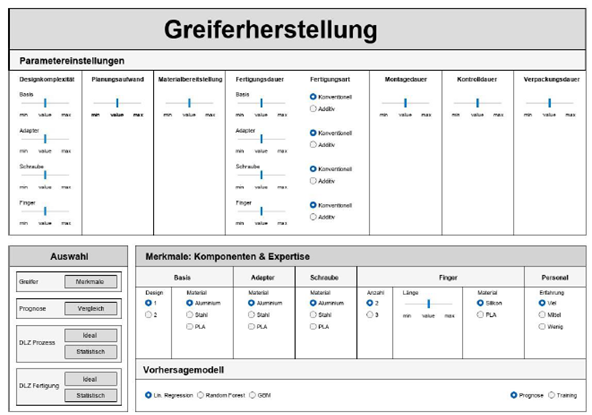
The results are evaluated using metrics such as Root Mean Square Error (RMSE), bias, and R². An interactive interface with adjustable parameters allows targeted influence on the simulation runs.
Results and Key Figures
- Improved forecasting accuracy through the combination of simulation and GBM models
– e.g., MSE of 154, R² up to 0.99 - High consistency between simulated and real lead times
– e.g., deviation < 0.01 hours in selected scenarios - Adaptive models through incremental training with new data
- Varying model quality: GBM performed better in comparison tests than LR and RF
- Flexibility through dynamic scenario management and ML integration
D10S Simulator – AI-supported optimization of order timing and order quantity
The D10S simulator demonstrates how machine learning and simulation can be combined to determine the optimal timing and appropriate quantity for material orders in single-item production. The aim is to reduce procurement costs by providing more accurate forecasts of raw material prices and integrating these forecasts into an ERP system for automated decision support.
Initial Situation
In markets with highly fluctuating raw material prices, timely and cost-efficient procurement poses a major challenge—particularly for small and medium-sized enterprises (SMEs) with limited storage capacity and financial resources. Classical procurement strategies often fail to adequately take this volatility into account, resulting in higher material costs and lower predictability.
Objective
The simulator aims to use advanced AI models (LSTM, ANN, CNN) to predict future raw material prices based on historical data. Based on these forecasts, order timings and quantities are determined automatically and transmitted directly to the ERP system (Odoo) via an interface. The decision criteria include minimum and maximum inventory levels as well as storage and procurement costs.
Technical Implementation
The application combines an AnyLogic simulation, Python-based forecasting models, and direct ERP integration. The system follows a daily decision-making cycle, which consists of four steps:
- Data retrieval: Historical raw material prices are retrieved via the Yahoo Finance API (using yfinance).
- Modeling: The models (LSTM, ANN, CNN) are trained with structured time series data.
- Forecasting: The future raw material price is predicted and evaluated.
- Order decision: The optimal quantity and timing are calculated and automatically transmitted to Odoo.
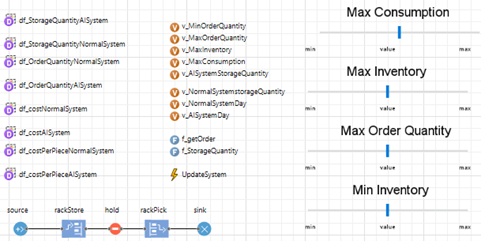
The simulation is carried out via agent-based modeling in AnyLogic. Variables such as inventory, consumption, and price thresholds can be interactively adjusted in a graphical interface.
Results and Key Figures
The models were compared using the metrics RMSE and R²:
- LSTM showed the best results with an average RMSE of 0.025 and an R² of 0.86.
- ANN achieved similar but slightly weaker results (RMSE: 0.028, R²: 0.81).
- CNN showed significantly higher variance (RMSE up to 0.08, R² sometimes < 0).
In an 80-day test phase using the steel price index as a basis, the LSTM-based ordering system achieved 4% lower procurement costs compared to a classical quantity-based approach. At the same time, an average purchase price of €3.70 per unit was achieved (classical: €3.85 per unit)
To see a video of this simulation go to our video page.
Further Observations:
- The AI-based system placed 50 smaller, flexible orders compared to 9 fixed bulk orders in the classical system.
- The average inventory level in the AI system was higher (91 instead of 40 units), as stock was deliberately built up at lower prices.
D14S Simulator – AI-supported maintenance strategy through process time analysis
The D14S simulator was developed to model and evaluate wear processes in assembly workstations of flexible manufacturing systems (FMS) based on deviations in process times. The aim is to make different maintenance strategies comparable under varied production conditions and to enable data-driven maintenance decisions.
Initial Situation
In FMS, direct indicators of mechanical wear are often not available. Instead, early malfunctions usually only become apparent through deviations in process times. Conventional condition monitoring methods reach their limits here, as they have difficulty distinguishing between normal fluctuations and wear-related anomalies.
Objective
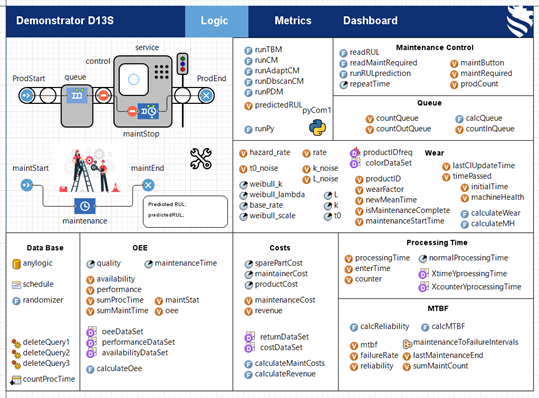
At the core of the simulator is an agent-based simulation model that realistically represents an assembly cell. Process times are simulated depending on component variants, product configuration, and workload. In addition, a statistical wear model was integrated, which dynamically changes the machine condition. The goal is to determine the optimal maintenance time on this basis and to evaluate different maintenance strategies under realistic conditions.
Technical Implementation
The system combines methods from simulation, condition monitoring, and machine learning. Specifically, the following approaches are used:
- Agent-based simulation in AnyLogic to map process flows and degradation dynamics,
- Anomaly detection models (Isolation Forest and One-Class SVM) to identify conspicuous process time deviations,
- A Gradient Boosting Machine (GBM) model to predict the Remaining Useful Life (RUL),
- A variable wear model based on logistic and Weibull functions to represent machine condition over time and usage.
In the simulation, five maintenance strategies are compared: reactive, time-based, classical condition-based, adaptive condition-based, and AI-based predictive maintenance.
Results and Benefits
The results show that the AI-supported approach achieves significantly higher machine availability and reliability compared to classical strategies. The average machine condition preservation was 95.48%, and the average system reliability was 70.59%. At the same time, maintenance could be planned more precisely, and wear could be predicted more accurately. Especially in comparison to time-based maintenance, a noticeable reduction of unnecessary maintenance activities was achieved.
The combination of both anomaly detection methods increased detection accuracy, while the GBM model was able to reliably predict maintenance dates. The agent-based simulation environment made it possible to compare all strategies under controlled conditions.